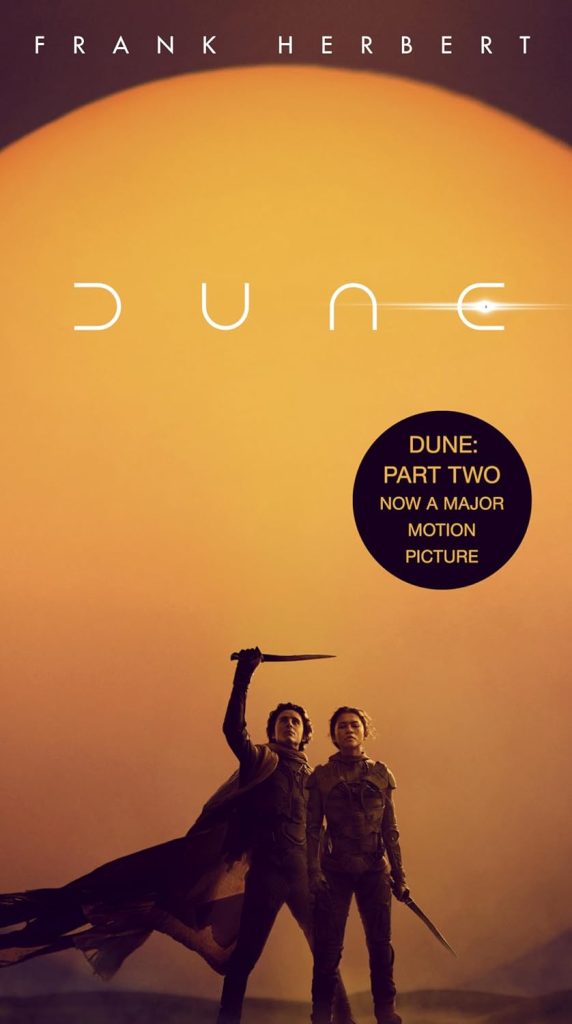
Title: Dune
Author: Frank Herbert
Genre: Epic Science Fiction, Political Thriller
Summary:
Young Paul Atreides, heir to a noble house, travels with his family to assume control of Arrakis, a harsh desert planet and the universe’s only source of spice, the most valuable substance in existence. After a brutal betrayal by their sworn enemies, the Harkonnens, Paul and his mother are forced into the lethal desert, where they must survive among the indigenous Fremen. As Paul adapts to the extreme environment and learns their ways, he unlocks latent abilities that propel him toward a destiny that could reshape the entire galaxy.
Content Guide:
- Violent battles, assassinations, and harsh survival conditions
- Depictions of drug-induced visions and psychological manipulation
- References to torture and oppressive political regimes
- No graphic sexual content or gratuitous language
My Thoughts:
I first discovered Dune back in high school as a battered paperback at the library. I remember liking it, but I lacked the depth of life experience and knowledge of the craft of writing to truly appreciate this classic. Revisiting the novel now as an author and creative writing instructor, I appreciate just how daring Herbert was with his pacing, exposition, and narrative style.
Other reviewers are welcome to talk about the depth of the worldbuilding, but for me, what sets this novel apart is the way internal conflict is handled. Conventional wisdom warns against head-hopping or switching POV characters midway through a scene, but Herbert breaks that rule with intention and expertise as most of the conflict happens in micro-expressions and anticipatory mental simulations. The cliche of comparing a story to a chess game is nonetheless most apt here. This isn’t a game of speed chess on the street. Slow characters still operate at two or three moves ahead, while skilled players are closer to half a dozen, providing unique perspective to the primary conflict of a character gaining universal precognition.
As compelling as this dynamic is, there is a real cost as more traditional tension around the immediate, physical world is minimized or even neglected. The iconic sandworms are little more than a minor plot device, and moviegoers expecting the same level of visual spectacle or heart-pumping action will not find it here. This isn’t meant as a pretentious judgement against readers looking for a more straightforward adventure. As much as I loved the cerebral machinations of the characters, I was bored with the lackluster set pieces and action sequences. The second half of the novel suffers from this especially as there’s less personal drama and not enough physical tension and detail to make up for it.
This book is not for casual readers. Its world is dense and immersive, its themes and style both complex and nuanced. Don’t read it for kaiju worms in the desert. Read it for deep world-building, intricate political scheming, and science fiction that explores the intersections of probability, ecology, politics, religion, and personal choice.
Disclaimer: This site contains affiliate links. If you click through and make a purchase, I may earn a commission at no additional cost to you. I only recommend products and services that I believe in and that may be of value to my readers. Thank you for your support!